
EEI Magazine – Winter 2025
The Winter 2025 edition of European Energy Innovation is here, featuring technical presentations by Techem, ONERA, and many more.

It is November 2025. I am writing this article in my cabin on the Stena Germanica, a methanol-fuelled ro-pax ferry serving the Gothenburg-Kiel route. I have spent the day in Sweden, testing the electric Zeekr 001 FR hatchback’s 2-second 0-100kmh time. Outside my porthole, over the freezing Kattegat, is the 400MW Anholt offshore wind farm, the flashing beacons of its 111 turbines piercing an obsidian sky.
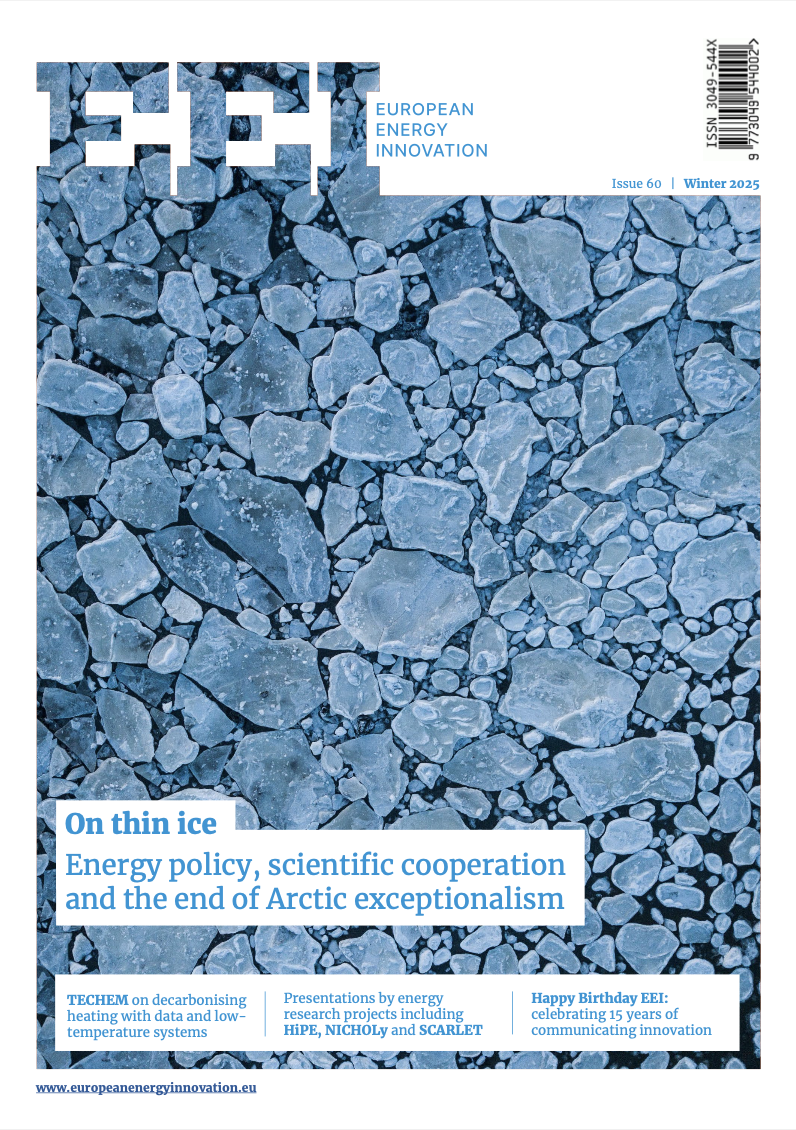
The Winter edition of EEI, featuring Techem, ONERA, Lufthansa, project introductions from NICHOLy, HiPE and SCARLET, and more.
Fifteen years ago, when the first edition of European Energy Innovation went to press, these were all plans for Europe’s near future. DONG Energy had been granted a licence for the Anholt installation but had yet to begin work, EVs were a nerdy novelty for early adopters who could tolerate their limitations, and Stena Line was participating in methanol research projects but was still half a decade away from converting this ship from diesel- only operation.
Its participants may grumble about delays, but the green transition is characterised as much by pace and momentum as by frustrations and bottlenecks. As European Energy Innovation reaches 15 years of age, it is inspiring to recognise how many technologies have evolved and matured within that timeframe from hopeful ideas, to encouraging lab tests, to successful pilots, to real-world implementation and, ultimately, to boring aspects of modern European life. I might be the sole passenger on this ship giving those faraway lights a second thought, which shows how far we’ve come in a very short space of time.
The EEI team has asked its friends from around the energy sector for their reflections on the past 15 years, and you can read their answers on pages 12-16. Meanwhile, we’ve been flicking through our back catalogue of editions – which is available for free on our website, below – to join the dots between 2010 in European sustainability R&I, and the world we live in today.
As it happens, wind has been notable in its maturation. In the Winter 2010 edition of EEI, journalist Philip Hunt reports that “by 2030, average turbine sizes of 2MW (onshore) and 10MW (offshore) are expected, with gigawatt- size wind farms likely for offshore”. In fact, the Siemens Gamesa turbines at Scotland’s Moray West are rated at 14.7MW each, and while that particular wind farm falls short of the projected gigawatt at a mere 882MW, Hornsea One and Two stand at 1.2GW and 1.3GW, respectively. Siemens Gamesa is currently testing a 21.5MW turbine with a rotor diameter of 276m.
The same article mentions the then- nascent technologies of wooden towers and vertical axis turbines, both of which are now being deployed. It also includes a chart that shows total installed capacity rising from 24,322MW in 2021 to an estimated 203,500MW in 2010; we know from our vantage point in 2025 that this chart climbs dramatically on its way to the 1.3TW-ish figure we’re approaching today. Analysts predict the next terrawatt will take one-third as long as the first one did.
“The growth in the use of electric cars has been far from spectacular,” grumbles former editor Michael Edmund in the Summer 2011 edition of EEI, pointing out the 160km range and multi-hour charging speed of most early EVs. The year before, just 600 new electric cars had been sold in Europe, resulting in a market share of a fraction of a percent. But unbeknownst to the author, a quiet revolution had already begun, and European EV sales had begun an ascent that the word “spectacular” doesn’t even begin to cover.
By the end of 2011, Europeans had bought around 7,000 new electric cars – a tenfold increase, and some, fuelled in part by the arrival of Nissan’s Leaf, which I enthuse about on page 12. The following year, and for several years after that, the figure increased by around 60 percent. Within five years, mass-market electric cars earned a market share of over a percent, then reached 10 percent by 2020, and then 20 percent by 2022.
When EEI was founded, Europeans bought 600 EVs a year; today, they’ll buy 600 EVs before lunchtime. Outside St Pancras or Bruxelles-Midi, I am as likely to find an electric taxi as I am a clattery old diesel one, an idea that felt almost space-age not long ago. It is remarkable how quickly these products have reached ubiquity.
It’s fair to point out that electric cars were invented a century ago, and that the past fifteen years represent their rapid evolution and popularisation, rather than their genesis. Like the first fish to squirm out of its Devonian ocean and onto dry land, the REVAi G-Wiz quadricycle (Britain’s most popular EV, in 2009) was just a small, ungainly part in a much grander process that includes primitive turn-of-the-century motor-wagens to the 1,265PS hypercar I’ve been hoofing up and down a Swedish airstrip all afternoon.
The Germanica was the world’s first methanol ro-pax ferry, and remains one of only a handful of ships that have been converted or, even rarer, to have been built to run on both fuels. Perhaps over the next 15 years this technology – or hydrogen lorries, or perovskite- tandem photovoltaic panels, or direct air capture, or gravity energy storage – will experience implementation booms just as EVs or offshore wind have since 2010.
We always welcome readers’ thoughts, so please do share your own predictions with the team via LinkedIn, our contact form, or by email.
It’s another particularly interesting issue this quarter, with brilliant submissions from expert writers across the green transition. In a few pages, Techem introduces its 2025 Atlas, with some insights into using consumption data and driving decarbonisation with heat pumps. The HiPE project explains its plans for wide-bandgap semiconductors in the automotive industry, the NICHOLy project talks about improving the storage of liquid hydrogen, and the SCARLET project discusses multi-gigawatt transmission using superconducting cables, which have important applications in various environments. And we have a unique glimpse into the darkened rooms of the European Solar Test Installation, written by Dr Christian Thiel, Head of the Energy Efficiency and Renewables Unit at the JRC.
In our aviation mini-dossier, we have technical presentations by Lufthansa, ONERA and Clean Aviation, while at the back of the magazine we have unique analysis by EEI writers Sam Meadows (on the political difficulties of lithium extraction) and Xiaoying You (who writes about the implications of India’s PV push). We also have our event listings, a special birthday feature, and more.
Later tonight, while I am hopefully sound asleep, the first-ever methanol ferry will chunter past the site of the first-ever offshore wind farm, Vindeby, which was built in 1991 and recycled in 2017. It had a nameplate capacity of 5MW. It is fun to look at the innovations, pilot schemes and real-world implementations being built today, and wonder what we might think of them – and the mark that they by then will have left on the green transition – in the decades to come.
Become a subscriber and receive the digital edition of European Energy Innovation every quarter.